A few months ago, I sat across from a toolmaker who’d been running a manual surface grinder in his small machine shop for 12 years. He pushed a crumpled sample of hardened tungsten carbide across my desk, its edges sharp enough to catch on fabric, and asked the question I hear surprisingly often: “Can my manual surface grinder even do anything with this stuff?” It’s not just him—most people I talk to, from hobbyists scaling up a one-man operation to small job shops testing a new material, assume tungsten carbide has to be ground with fancy CNC equipment. Let me break down what I’ve learned from years of working with manual surface grinders, the clients who’ve put them to work on carbide, and the hard science that makes that work possible. Manual Surface Grinder
First, let’s get the basics straight: tungsten carbide is not just another hard metal. It’s a composite material, made by mixing tungsten carbide particles (usually 80-95% of the mix) with a binder metal, almost always cobalt, then sintering it at temperatures over 1,400°C. That sintered structure is what gives carbide its legendary hardness—Rockwell C values usually between 80 and 94, compared to tool steel’s 60 to 70 at its hardest. For context, diamond sits around 10 on the Mohs scale, and carbide is a 9 to 9.5; most common grinding wheels are Mohs 7 or lower, so you can’t just grab a standard wheel and expect it to cut. That’s the biggest myth I run into: that carbide is too hard for manual machines. It’s hard, but not ungrindable—especially if you match the right grinder setup to the material’s properties.
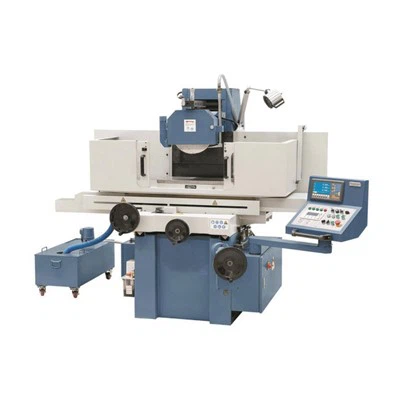
Let’s talk about the manual surface grinder specifically. I know a lot of people write these machines off as old-school, as if CNC does every job better. But my best-selling manual surface grinder models are the ones with rigid, cast-iron bases, precision hand-scraped ways, and enough horsepower to handle consistent cuts without vibrating. Vibration is the enemy when grinding carbide; it causes micro-cracks in the sintered structure that make the final part fail, or worse, chip mid-job. I had a client in Ohio last year who tried his beat-up, 20-year-old manual surface grinder with a wobbly spindle to grind carbide inserts for farming equipment. He ended up with 12 broken inserts, and the edges were so rough he had to send them out for re-grinding. Once he upgraded to a rigid grinder with a properly aligned spindle, his failure rate dropped to less than 2%. Rigidity isn’t a nice-to-have for carbide—it’s non-negotiable.
Next, the grinding wheel. This is where 90% of the success or failure happens. You can have the best grinder on the market, but if your wheel is wrong, you’ll get nowhere. Tungsten carbide requires a wheel that’s sharp enough to shear the hard tungsten carbide particles without loading up on the cobalt binder. The three key specs here are bond type, grit size, and structure. Most new grinders come with aluminum oxide wheels, and while those work great for steel, they’re way too soft for carbide. The go-to for carbide is usually a silicon carbide wheel—specifically, a green silicon carbide (GC) wheel. Green silicon carbide is harder than aluminum oxide, has sharp, angular grains that fracture cleanly, and doesn’t clog as easily with cobalt. That’s not the only option, though; some clients use cubic boron nitride (CBN) wheels for finish work, especially on smaller, high-precision parts. CBN is even harder than silicon carbide, lasts much longer, and produces a smoother finish, but it’s more expensive upfront. For job shops grinding carbide in batches of 10 to 50 inserts, green silicon carbide is the sweet spot—it’s affordable, readily available, and does the job well if used correctly.
Grit size is another big one. If you’re rough grinding carbide—removing a lot of material quickly—you want a coarser grit, like 60 or 80. But if you’re doing finish grinding, getting a tight tolerance and a smooth surface, you’ll go finer: 120, 180, even 240 grit. I always tell clients to start with a mid-range grit, like 100, and adjust from there. I’ve seen a guy in Michigan try 320 grit for a rough grind and burn through his wheel in an hour. Don’t make that mistake. Also, structure refers to how densely the grains are packed on the wheel. For carbide, you want an open structure—meaning fewer grains per square inch—because that gives the swarf (the tiny chips of carbide and cobalt) room to escape. Closed structure wheels load up fast on the soft cobalt binder, which makes the wheel stop cutting and creates heat that burns the carbide.
Heat is the silent killer when grinding carbide. Tungsten carbide has low thermal conductivity, so heat doesn’t spread away from the cutting zone like it does with steel. If you generate too much heat, you get thermal shock—the carbide cracks, becomes brittle, and can even shatter. That’s why coolant is non-negotiable. I can’t stress this enough: if you’re grinding carbide on a manual surface grinder, you must use a flood coolant system, not just a mist. Mist doesn’t penetrate the cutting zone enough to pull heat away. I recommend a soluble oil coolant or a synthetic coolant formulated for carbide grinding—they lubricate the wheel, reduce friction, and keep temperatures low. A friend of mine runs a tool and die shop in Indiana who used to run dry on his old grinder to save time, and he told me after switching to flood coolant, his wheel life doubled, and he didn’t have a single cracked part in six months. It’s a small change that makes a huge difference.
Now, let’s talk about what you can actually do with a manual surface grinder and carbide, because I know you’re wondering if it’s just for tiny parts or low-volume work. The truth is, my clients are grinding all kinds of carbide parts on their manual grinders: carbide inserts for machining, wear strips for construction equipment, nozzles for oil and gas, even custom knife blades for bladesmiths. A bladesmith in Colorado reached out to me last year because he was tired of sending his carbide blade blanks out for grinding, which took two weeks and cost a fortune. He bought my entry-level manual surface grinder, a basic model with a magnetic chuck, and now he grinds his own blades in-house. He told me last month that he’s cut his blade production time in half, and the edge quality is better than what he was getting from the local machine shop.
I won’t lie to you—there are limitations. If you’re grinding parts that need tolerances tighter than 0.0005 inches, or parts with complex geometries, a CNC surface grinder is going to be more consistent and faster. Manual grinders do require a skilled operator, someone who can feel the feed, adjust the wheel, and notice when the coolant flow is off or the wheel is loading. It’s not a set-it-and-forget-it machine like a CNC, but if you have a good operator and you follow the right setup steps, you can get results that are more than good enough for most small to medium production runs.
Let me walk you through a typical setup I recommend for a client looking to grind carbide on a manual surface grinder. First, the grinder: pick a rigid model with at least 2 horsepower, a precision spindle, and a table that moves smoothly. Skip the cheap, hobbyist-grade grinders that don’t have enough rigidity. Next, the wheel: a green silicon carbide wheel, grade J (medium hardness), grit 100, open structure. That’s a versatile setup that works for rough and finish work on most carbide grades. Then, the coolant: a flood system with synthetic coolant, set to flow at about 5 gallons per minute directly to the grinding zone. The magnetic chuck: make sure it’s strong enough to hold carbide parts—carbide is dense, so a weak chuck might slip mid-grind, which can damage the part or the wheel. Finally, take light cuts. Don’t try to remove 0.010 inches of material in one pass. Start with 0.001 to 0.002 inches per pass, and only increase the depth if you’re comfortable and the wheel is cutting smoothly.
I’ve seen so many small businesses write off manual surface grinders and carbide because someone told them they can’t do it. But the proof is in the parts. I had a job shop in Texas that was grinding carbide wear pads for a local construction company. Before they upgraded their grinder and setup, they had a 15% scrap rate, and each part took them 20 minutes to grind. After switching to my recommended setup—rigid grinder, GC wheel, flood coolant, light passes—their scrap rate dropped to 2%, and each part took 12 minutes to grind. That’s a 40% increase in productivity and thousands of dollars saved per month.
Is there a time when a manual surface grinder isn’t the right choice? Sure. If you’re doing high-volume production of small, identical parts, or if you need extremely tight tolerances, CNC is better. But for small job shops, hobbyists, or custom work, manual grinders are more than capable. They’re affordable, easy to maintain, and skilled operators are easier to find than CNC programmers these days.
At the end of the day, the question isn’t “Can a manual surface grinder be used for grinding tungsten carbide?” It’s “Can your manual surface grinder be set up and operated correctly to grind tungsten carbide?” The answer is almost always yes. You just need the right setup, the right wheel, and a little bit of know-how. If you’re a small shop owner, a bladesmith, or anyone working with carbide, and you’re tired of sending parts out for grinding or dealing with bad results from an old grinder, let’s talk. I’ve helped dozens of clients set up their grinders to work with carbide, and I can help you too. No pressure, just honest advice from someone who’s been in this business for years and seen what works.
Centerless Grinding Machine References
- Tönshoff, H. K., Arendt, C., & Ben Amor, R. (2000). Grinding of hard metals. CIRP Annals, 49(2), 587-599.
- Shaw, M. C. (1996). Principles of Abrasive Processing. Oxford University Press.
- American Society for Metals. (1989). Surface Grinding of Hard Materials. ASM Handbook, Volume 16: Machining.
- Marinescu, I., Inasaki, I., & Uhlmann, E. (2004). Handbook of Ceramic Grinding and Polishing. William Andrew Publishing.
Wuxi Mingxu Machinery Equipment Co., Ltd.
As one of the most professional manual surface grinder manufacturers and suppliers in China, we’re featured by quality products and good price. Please rest assured to buy the best manual surface grinder for sale here from our factory. Also, custom service is available.
Address: No. 5-5 Jinke Wealth Plaza, Changjiang North Road, Xinwu District, Wuxi City, Jiangsu Province
E-mail: yingyingmxjd@163.com
WebSite: https://www.mingxu-china.com/
